Introduction
Efficient IT Asset Management (ITAM) is no longer optional—it’s a necessity. Businesses today rely on ITAM solutions to track hardware, software, licenses, and digital infrastructure that keep operations running smoothly. But one question arises for every IT leader: Should you go for a cloud-based ITAM or an on-premise ITAM?
The answer isn’t one-size-fits-all. Both deployment models have advantages and challenges, and the right choice depends on your organization’s size, budget, industry, and compliance needs.
In this blog, we will:
- Introduction: Cloud ITAM, On- premise ITAM
- Comparison cloud and on-premise ITAM.
- Features of cloud and on-premise
- Discuss scenarios where each model fits best.
- which is right for your business.
Cloud ITAM
Cloud ITAM is a Software-as-a-Service (SaaS) model where IT asset management runs on a cloud provider’s infrastructure. The software is hosted, maintained, and updated by the vendor, while organizations access it via the internet.
Example scenario: A mid-sized digital marketing agency with remote employees adopts cloud ITAM to track laptops, SaaS subscriptions, and employee usage across multiple geographies. The cloud model ensures accessibility anytime, anywhere, without investing in on-site infrastructure.
Key Characteristics:
- Accessible remotely through a browser.
- Subscription-based pricing.
- Vendor handles updates and security.
On-Premise ITAM
On-premise ITAM is installed locally on a company’s servers and managed by in-house IT teams. The organization is responsible for infrastructure, updates, and security.
Example scenario: A banking firm with strict data compliance regulations chooses on-premise ITAM to ensure sensitive financial data stays within its controlled environment.
Key Characteristics:
- Installed and hosted on company-owned servers.
- Higher upfront costs, but full control.
- Customizable to organizational needs.
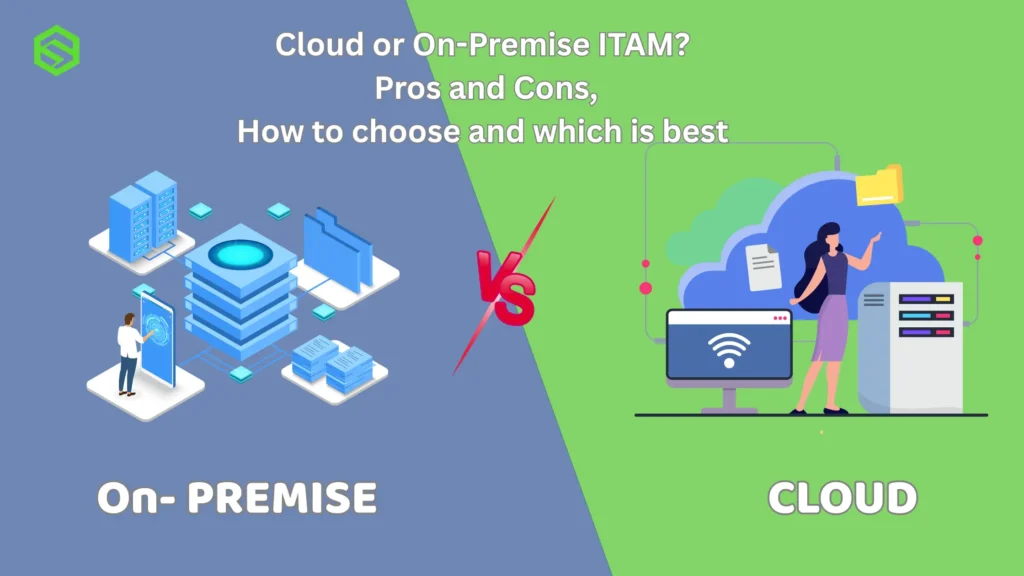
Cloud vs On-Premise ITAM: Comparison
Feature | Cloud ITAM | On-Premise ITAM |
Deployment | Hosted by vendor, accessed online | Installed on local servers, managed in-house |
Cost | Subscription-based (OPEX) | One-time license + infrastructure (CAPEX) |
Scalability | Easily scalable with business growth | Limited, requires hardware upgrades |
Maintenance | Vendor handles upgrades & patches | IT team responsible for updates & backups |
Data Security | Depends on vendor’s compliance | Full control, ideal for sensitive industries |
Accessibility | Remote-friendly, ideal for hybrid teams | Mostly local, remote access needs VPN |
Speed of Deployment | Quick setup, minimal IT effort | Longer setup, requires IT expertise |
Customizability | Limited, based on vendor features | Highly customizable as per business needs |
Key Features of Effective On-Premise IT Asset Management
- Complete Data Control
- Data stays within the organization’s servers, ensuring maximum control and security.
- Suitable for industries with strict compliance (banking, defense, healthcare).
- Data stays within the organization’s servers, ensuring maximum control and security.
- Customizability
- Can be tailored extensively to match business processes and integrate with internal systems.
- Supports unique workflows or compliance rules.
- Can be tailored extensively to match business processes and integrate with internal systems.
- High Security for Sensitive Environments
- Security protocols are fully managed internally.
- No third-party involvement in storing or processing critical data.
- Security protocols are fully managed internally.
- Offline Availability
- Assets can be tracked and managed within local servers even if the internet is down.
- Assets can be tracked and managed within local servers even if the internet is down.
- Long-Term Cost Efficiency (CAPEX)
- Higher upfront cost but avoids recurring subscription fees.
- Becomes cost-effective in the long run for organizations with stable infrastructure.
- Higher upfront cost but avoids recurring subscription fees.
Key Features of Effective Cloud IT Asset Management
- Remote Accessibility
- Users can access ITAM anytime, anywhere, using a browser or mobile device.
- Perfect for remote teams and distributed organizations.
- Users can access ITAM anytime, anywhere, using a browser or mobile device.
- Scalability
- Easily scale up or down based on the number of assets or users.
- No need for heavy hardware investment.
- Easily scale up or down based on the number of assets or users.
- Automatic Updates & Maintenance
- Vendor handles software patches, feature updates, and backups.
- Reduces IT workload and ensures the system is always current.
- Vendor handles software patches, feature updates, and backups.
- Subscription-Based Pricing (OPEX)
- Lower upfront costs with predictable monthly or annual fees.
- Easier for SMEs to adopt without capital investment.
- Lower upfront costs with predictable monthly or annual fees.
- Integration with Modern Tools
- Connects seamlessly with SaaS apps, cloud storage, and other IT systems.
- Offers APIs for faster automation and reporting.
- Connects seamlessly with SaaS apps, cloud storage, and other IT systems.
- Advanced Analytics & Dashboards
- Provides real-time insights into asset usage, license compliance, and costs.
- Helps decision-making with centralized reports accessible from anywhere.
Cloud vs On-Premise ITAM: Which Fits Your Business?
Let’s look at scenarios:
- For Small to Medium Enterprises (SMEs):
- Best choice: Cloud ITAM
- Reason: Affordable subscription, easy deployment, minimal IT staff required.
- Best choice: Cloud ITAM
- For Enterprises in Regulated Industries (Healthcare, Finance):
- Best choice: On-Premise ITAM
- Reason: Strict compliance and data sovereignty requirements.
- Best choice: On-Premise ITAM
- For Global Businesses with Remote Teams:
- Best choice: Cloud ITAM
- Reason: Remote access, scalability, and minimal infrastructure hassle.
- Best choice: Cloud ITAM
- For Organizations with In-House IT Expertise and Capital Budget:
- Best choice: On-Premise ITAM
- Reason: Control and customizability outweigh maintenance challenges.
- Best choice: On-Premise ITAM
👉 If you are exploring ITAM features, read our blog on 10 Must-Have Features in a High-Performance Asset Management Software to understand what capabilities to look for.
Hybrid ITAM: The Middle Ground
Some organizations adopt a hybrid model, blending cloud and on-premise ITAM. For instance, a retail company may keep sensitive POS systems on-premise but manage SaaS subscriptions via cloud ITAM. This approach balances security with flexibility.
How to Choose the Right ITAM for Your Organization
When deciding between cloud and on-premise ITAM, ask these questions:
- What is my budget for upfront vs recurring costs?
- Do I need remote accessibility for global teams?
- What are my industry’s compliance requirements?
- Do I have an in-house IT team for ongoing maintenance?
- How quickly do I expect my IT assets to scale?
By evaluating these factors, you can make an informed decision tailored to your organization’s priorities.
Final Thoughts
Both cloud and on-premise ITAM solutions have their strengths. Cloud ITAM offers agility and lower entry costs, while on-premise ITAM ensures security and control. The right choice depends on your business goals, compliance obligations, and IT maturity.
💡 Want to see how ITAM can transform your organization? Book a Free Demo Today.